🚀 Building my first SaaS with FastAPI and PostgreSQL: the real errors that almost broke my backend
💡 What I learned building a course platform while I am still learning web development.
In this article
- 🧱 The project: my first real SaaS
- ❌ Error #1 — Confusing SQLAlchemy models with Pydantic models
- ❌ Error #2 — UUID vs Integer in PostgreSQL
- ❌ Error #3 — PgBouncer and the mysterious statement_cache_size
- ❌ Error #4 — A forgotten Depends(get_db)
- ❌ Error #5 — The mysterious import error in Python
- 💡 What I am really learning
- 🚀 Next steps in the project
What I learned building a course platform while I am still learning web development.
When I started building my first SaaS I thought the challenge would be getting the features to work: authentication, courses, users, database, and so on.
But the reality was something else.
The real challenge was fixing all the unexpected errors that show up when you connect many pieces at once: FastAPI, PostgreSQL, SQLAlchemy, asyncpg, Docker, PgBouncer… and your own architecture decisions.
In this article I want to share some of the real errors I hit building my online course SaaS, because a lot of them do not appear in tutorials.
And honestly, it was these errors that taught me the most.
🧱 The project: my first real SaaS
I am currently building an online course SaaS platform using:
- 🅰️ Angular for the frontend
- ⚡ FastAPI for the backend
- 🐘 PostgreSQL deployed on Supabase
- 🔗 SQLAlchemy + asyncpg for database access
The idea is to create a platform where:
- instructors can create courses
- students can enrol
- the system manages users, roles and content
Nothing extremely complex… until you start building it.
❌ Error #1 — Confusing SQLAlchemy models with Pydantic models
One of the first mistakes I made was mixing up responsibilities between models.
At first I tried to use the same model to:
- represent data in the database
- validate data coming from the frontend
- return API responses
But that started breaking things very fast.
SQLAlchemy expects columns, relationships and table metadata. Pydantic is designed for data validation and serialisation. They are different tools with different purposes.
The solution was to separate them clearly:
Database model:
class User(Base):
    __tablename__ = "users"

    id = Column(UUID, primary_key=True)
    email = Column(String)
API schema:
class UserCreate(BaseModel):
    email: EmailStr
    password: str
It looks obvious once you see it, but at the beginning it can be confusing.
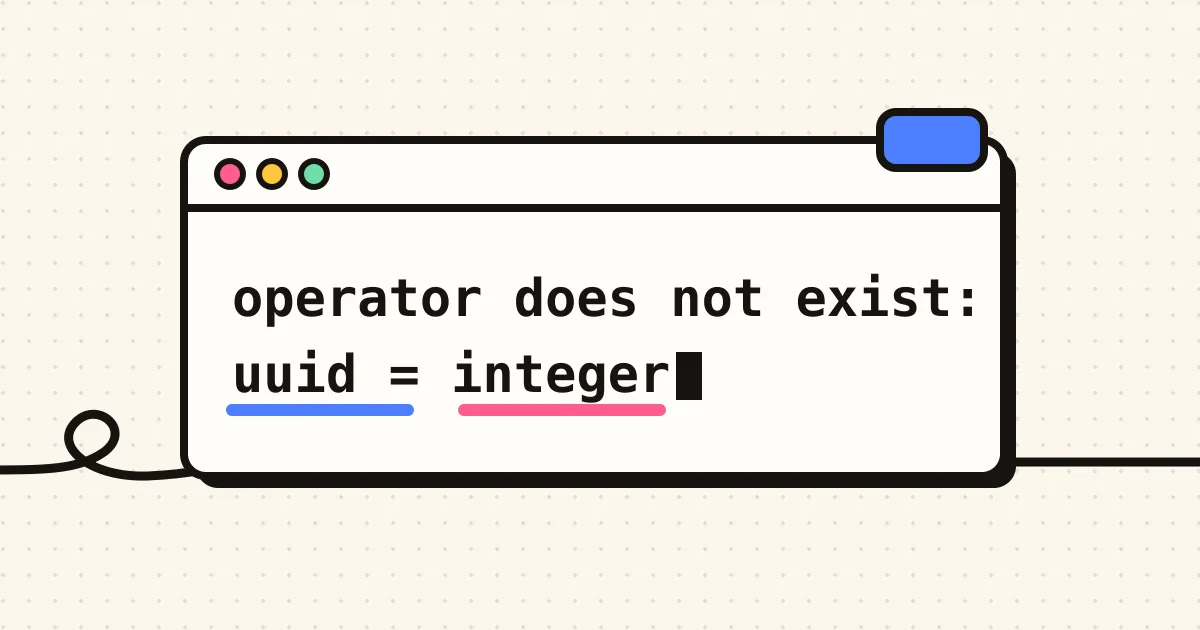
❌ Error #2 — UUID vs Integer in PostgreSQL
This was one of those bugs that makes you think everything is broken.
My PostgreSQL database used UUID as identifiers, but in some backend models I had defined the field as Integer.
Result: strange errors when SQLAlchemy tried to run queries:
operator does not exist: uuid = integerThe problem was not PostgreSQL. It was my incorrect model.
👉 If your database uses UUID, your backend must use UUID consistently too.
❌ Error #3 — PgBouncer and the mysterious statement_cache_size
When I deployed the database on Supabase an error appeared that I had never seen before.
Everything seemed to work… until errors related to prepared statements started showing up.
The culprit turned out to be PgBouncer, which many platforms use to manage connections.
The solution was to add this setting to the SQLAlchemy engine:
statement_cache_size=0It is not something that normally shows up in tutorials, but it can break your application if you use asyncpg + PgBouncer.
❌ Error #4 — A forgotten Depends(get_db)
Another classic error.
I had endpoints working perfectly… until one started failing for no apparent reason.
After reviewing everything, the problem was simply that I had forgotten to inject the database session dependency into the endpoint signature:
# ❌ Without injection — the session is not available
async def get_user(user_id: UUID):
    ...

# ✅ With correct injection
async def get_user(user_id: UUID, db: AsyncSession = Depends(get_db)):
    ...
That small detail means FastAPI does not inject the database session.
Sometimes the problem is not architecture. Sometimes it is a line you forgot.
❌ Error #5 — The mysterious import error in Python
This one cost me quite a bit of time.
The project had several modules, and some imports started failing with no clear explanation.
The cause: a single file was missing.
__init__.pyWithout that file, Python does not recognise the directory as a module. Another lesson learned.
💡 What I am really learning
Building this SaaS is teaching me something important:
Programming is not just writing code that works.
It is understanding how all the pieces of the system interact:
- ⚙️ the framework
- 🧠 the ORM
- 🗄️ the database
- 🚀 the deployment system
- 🔄 the async libraries
And very often the learning comes when something breaks.
🚀 Next steps in the project
My goal now is to keep developing the platform by adding:
- 📚 course management
- 🎓 a student enrolment system
- 👨🏫 an instructor panel
And plenty more interesting errors will surely appear.
When that happens… I will probably write another article. 😄
🔗 Project repositories and links
If you want to see how the project is going or look at the code:
💻 Backend
🐍 FastAPI + PostgreSQL + SQLAlchemy
👉 https://github.com/LauMontironi/SaaS-LMS-Backend-FastAPI-PostgreSQL
🎨 Frontend
⚡ Angular + API integration
👉 https://github.com/LauMontironi/SaaS-LMS-Frontend-FastAPI-PostgreSQL
🎥 Project demo
👉 https://go.screenpal.com/watch/cOeoXPnZHfx
🌐 Portfolio
👉 https://mi-portfolio-dev-laura-montironi.vercel.app/
💡 breaking things is part of the process.
And very often real errors teach you more than any tutorial.
Topics